Mechanistic Insights into Nanobody-Based Quenchbody Sensing via Structural Modeling and Molecular Simulations
Abstract
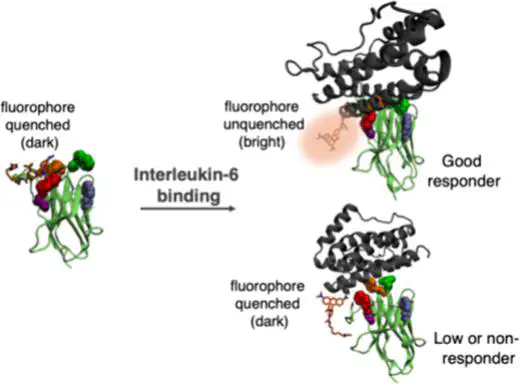
Nanobody-based quenchbodies are powerful fluorescent sensors for detecting biomolecular targets. They rely on tryptophan residues in the antigen-binding site that can quench (darken) a fluorophore attached via a flexible linker; antigen binding displaces the fluorophore and increases the fluorescence. Quenchbodies targeting interleukin-6 (IL-6) exhibit variable fluorescence responses despite comparable antigen binding, prompting an investigation into the underlying mechanism. We combined data-driven structural prediction with molecular dynamics simulations and first benchmarked HelixFold3 against AlphaFold3 using nanobody–lysozyme complexes, finding that HelixFold3 provided more accurate models. We then used HelixFold3 to predict the nanobody–IL-6 structures. Our analyses revealed that low and nonresponders retain solvent-exposed tryptophan residues upon antigen binding, enabling continued fluorophore quenching and reduced fluorescence. In contrast, good responders bury these tryptophan residues, limiting quenching and enhancing the signal. These results show that integrating data-driven structural prediction with molecular dynamics simulations can decode quenchbody mechanisms and guide the rational design of improved biosensors.

Lisanne Spenkelink
Senior Research Fellow
My research focusses on the development and use of single-molecule visualisation methods to study dynamics in complex biological systems.